
Redding Records Access at a Glance
Redding open records are divided by the government unit that made or received them. The county Recorder keeps the official-document index and local certificates. The Assessor and GIS offices describe parcels through different datasets. Shasta Superior Court controls court cases, while the City of Redding manages city legislation, permits, and agency files. The table leads with the practical route for each set and does not claim an online start year where the official source did not publish one.
| Redding record set | Responsible keeper | Digital route | How access works |
|---|---|---|---|
| Deeds, liens, and maps | Shasta County Recorder | Public Web Self Service | Free index; request images or copies by phone, mail, or counter |
| Civil, criminal, family, and probate cases | Shasta Superior Court | Public Portal | Public case data online; some documents require courthouse access |
| Assessment and parcel data | Shasta County Assessor and GIS | Assessment inquiry and map viewers | Current assessment or spatial data; office fallback |
| Birth, death, and public marriage certificates | Shasta County Recorder or CDPH | Forms and order routes | Authorized or informational copy rules apply |
| City legislation, permits, and department files | City of Redding | Records portal, JustFOIA, and permit search | Search or submit a focused city request |
| Sheriff and police reports | Shasta Sheriff or Redding Police | No broad public report index found | Form, email, phone, or agency request; redactions may apply |
Voter information is a separate, purpose-limited record set rather than a normal open file. Juvenile and sealed cases, protected addresses, some investigative material, confidential marriage files, military discharges, and sensitive identifiers also have special limits. A portal listing does not mean every underlying page can be viewed or downloaded.
Redding Recorder Index Boundaries
The Shasta County Assessor-Recorder accepts and indexes deeds, liens, notices, maps, and other recordable instruments. Its Public Web Self Service is an index, not the document itself. The Recorder compares it to a library card catalogue and warns users to try spelling variants. Images are not available online. A user can create an official-record or map-copy request in the portal, but payment must follow by phone, mail, or an office visit. The database is updated nightly Monday through Friday.
That distinction matters when a name match appears. An index entry points toward a recorded document, while the document supplies the legal language and context. Names may be abbreviated or indexed under different spellings. Recording dates, roles, document types, numbers, and book-page references help separate people with similar names.
- Index
- A finding aid that points to a filed record.
- Image
- A scan or reproduction of the underlying document.
- Certified copy
- A copy the custodian formally attests is true.
- Custodian
- The office responsible for keeping and releasing a record.
- Exemption
- A legal reason an agency may withhold or redact material.
Note: Search the Recorder index with initials, former names, and likely spelling variants before concluding that no Redding record exists.
Shasta Recorder Search Fields
The portal supports several routes, so a weak name search is not the end of the inquiry. A document number can reach a known filing directly. Book and page fields support older references, while grantor and grantee fields separate the person transferring an interest from the person receiving it. Date ranges reduce false matches.
| Portal field | Input style | Best use |
|---|---|---|
| Name with start and end dates | Text plus date range | Narrow a party search by recording period |
| Advanced name matching | Toggle | Broaden name variations |
| Grantor and grantee | Separate text fields | Search transfer roles |
| Document type | Multi-select plus dates | Limit results to a filing class |
| Document number | Text | Open a known index reference |
| Book, volume, and page | Reference fields | Find recorded documents or maps |
Copy prices are part of the access decision. Recorded-document copies cost $4.60 for the first page and $0.60 for each added page. Certification costs $2.60 per document. Map copies cost $10.40 for the first page and $1.60 for each added page.
The official Recorder fee schedule shows the current charges and recording-related items.
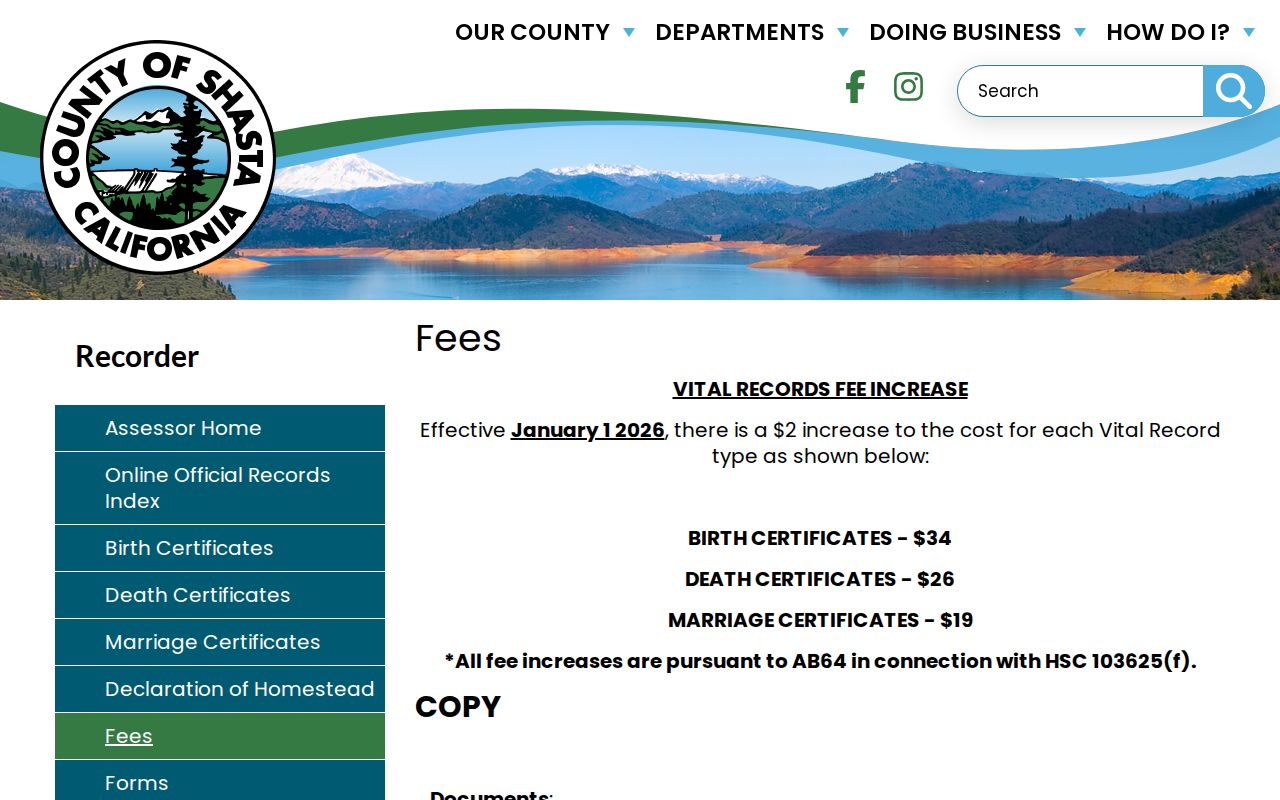
The schedule helps distinguish an index search from the paid copy, map, certification, or filing service that may follow.
Redding Property Records by Jurisdiction
Redding public records for property are split across legal, assessment, map, and permit systems. A Redding mailing address does not always prove that the city holds the permit, code, or map record. Some nearby parcels lie in unincorporated Shasta County. Check the jurisdiction field in county GIS or the city map before choosing a permit office. The city viewer supplies city overlays such as zoning, general plan, floodplain, utilities, and parcel reports. County GIS supplies parcel boundaries, assessment numbers, address points, planning layers, and jurisdiction data.
The Assessor inquiry is another system. It searches by fee parcel, assessment number, boat CF number, or aircraft tail number. It does not advertise owner-name searching in the published instructions. A full assessment number uses 12 digits, such as 123-456-789-654. Partial segmented searches may use a book, book-page, or longer block. The Shasta parcel dataset was updated in June 2025 for fiscal-year 2024-25 changes, but a map layer is still not a certified ownership record.
The Shasta County assessment inquiry instructions show the approved search choices and number format.
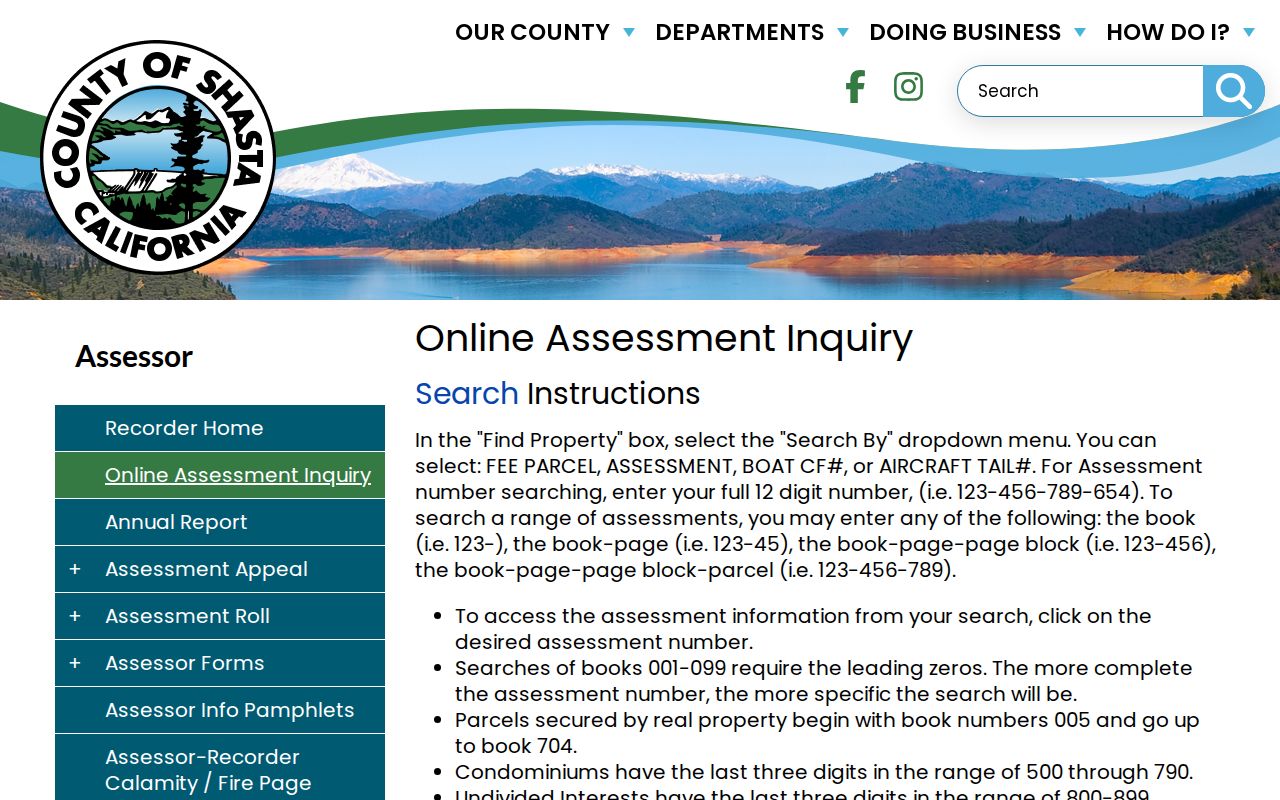
The screen explains why an address alone may not work and why the correct parcel or assessment identifier often unlocks the result.
Geography check. Confirm whether the parcel is inside Redding before sending a permit or code request to the city instead of Shasta County.
Redding Court Records Beyond Portal
Redding public records from court cases use a separate judicial channel. Shasta Superior Court runs the Public Portal for electronic case information. Public users see general-access data, while authorized justice partners may seek elevated access. California Rule of Court 2.503 limits remote display of certain court documents. That limit does not always mean the record is sealed. The court says some material may still be available for viewing through its Records Department at 1515 Court Street in Redding.
Criminal name searches cover Shasta County cases, not a statewide criminal-history file. A written request can be mailed or presented to the Criminal Clerk, with return by pickup or mail and a self-addressed stamped envelope. For record searches and copies, the court directs users to local form CF-055 and accepts a check or money order payable to Shasta County Superior Court. Civil and probate indexes can identify parties, case numbers, filing dates, and events, but the official research did not verify the portal's exact Smart Search labels or a sample docket. No unverified fields should be assumed.
The court's case-records access page explains the public portal, registered access, and remote-display limits.
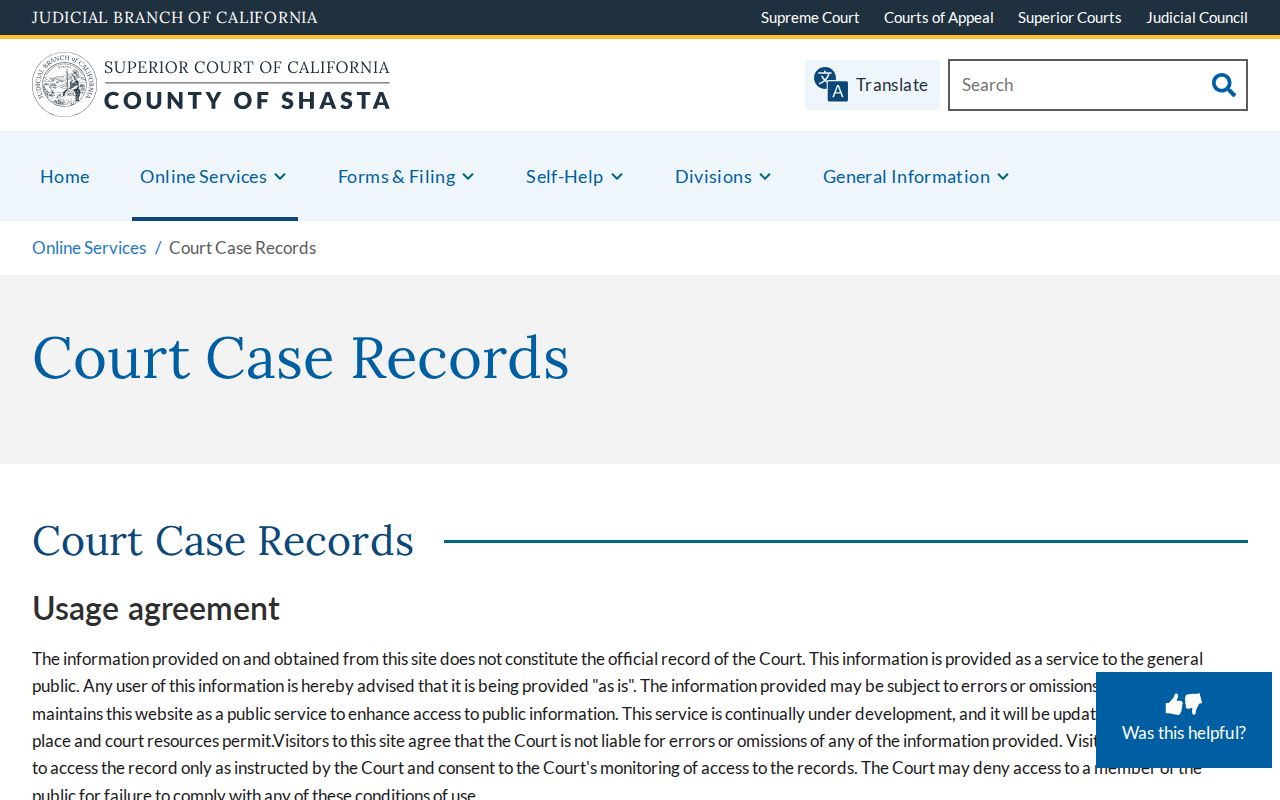
The page makes the online-versus-courthouse distinction clear, which can prevent a mistaken claim that no court document exists.
Redding Vital Records Copies and Fees
Vital certificates within Redding public records follow copy-eligibility rules rather than ordinary document access. The Shasta County Recorder issues certificates for births and deaths that occurred in the county and public marriages licensed there. The office accepts in-person applications, mailed forms, and a VitalChek route. Mail and VitalChek requests for authorized copies require a notarized sworn statement. Local pages state that processing takes one to three working days after receipt. Cash, check, and cards are accepted in person, with an added card fee. Cash should not be mailed.
California Health and Safety Code § 103526 limits who may receive an authorized certified copy. Other applicants may obtain an informational copy where the law permits. Confidential marriages are restricted to the spouses or a person with a court order. Marriage location can also mislead: the right county is the county that issued the license, even when the ceremony took place elsewhere. The statewide CDPH route is useful for events outside Shasta County or when state coverage is needed.
The Shasta birth-certificate request page sets out the three order methods, eligibility, and facts needed to locate a record.
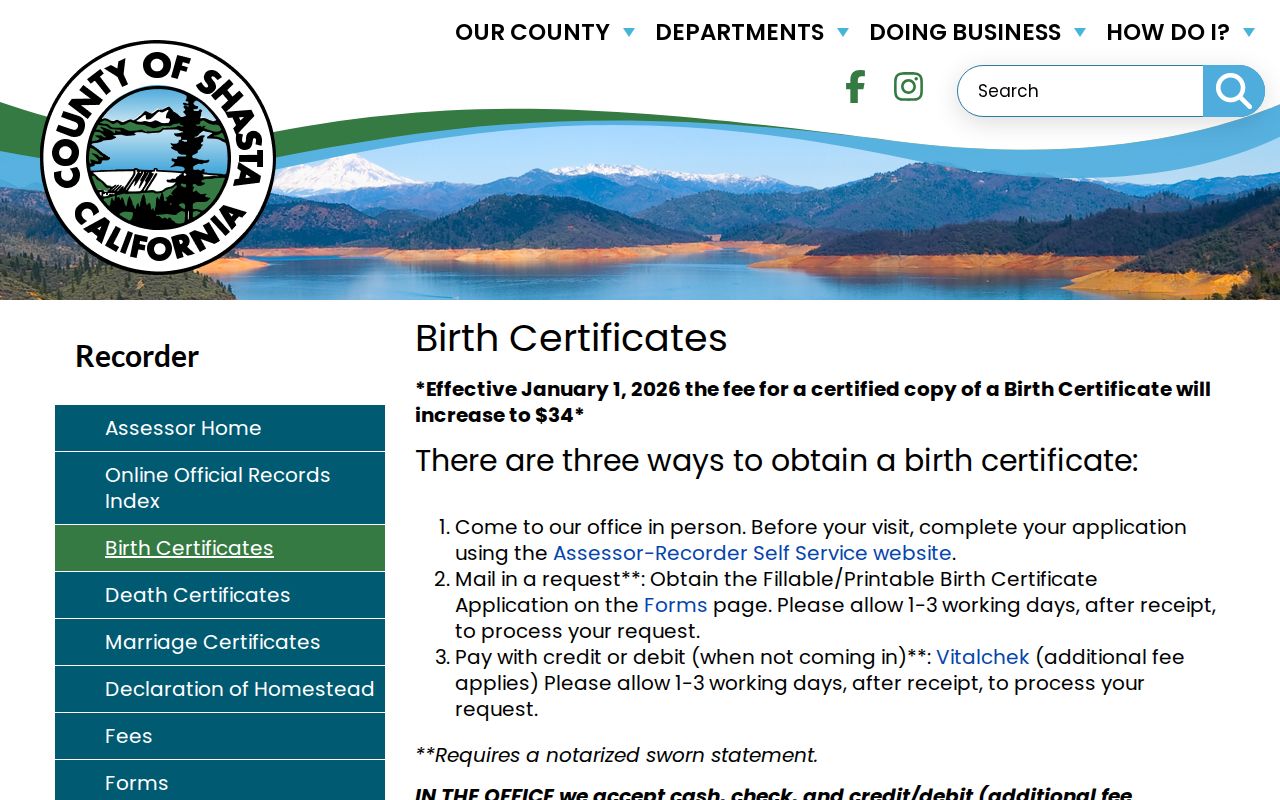
The application route asks for the child's full name and birth date, the mother's maiden name, the father's name when applicable, and place of birth.
Fee warning. A failed county vital-record search still costs the certificate fee under Health and Safety Code § 103650.
Effective January 1, 2026, Shasta County charges $34 for a birth certificate, $26 for a death certificate, and $19 for a marriage certificate.
Redding Public Records Offices
Redding is the Shasta County seat, so several main counters sit within a few blocks downtown. Send a request to the office that owns the record. A general county request cannot replace a court filing request, and the city's portal does not control county deeds.
Shasta County Assessor-Recorder
1450 Court Street, Suite 208
Redding, CA 96001
Shasta County Clerk
1450 Court Street, Suite 108
Redding, CA 96001
530-225-5730
Shasta Superior Court
1515 Court Street
Redding, CA 96001
Records Department and clerk counters
Shasta Building Division
1855 Placer Street, Suite 102
Redding, CA 96001
530-225-5761
The Recorder's forms collection supports certificate orders, DD-214 requests, preliminary change of ownership reports, transfer-tax material, and restrictive-covenant modification requests.
The Recorder forms page groups the official applications by record type.
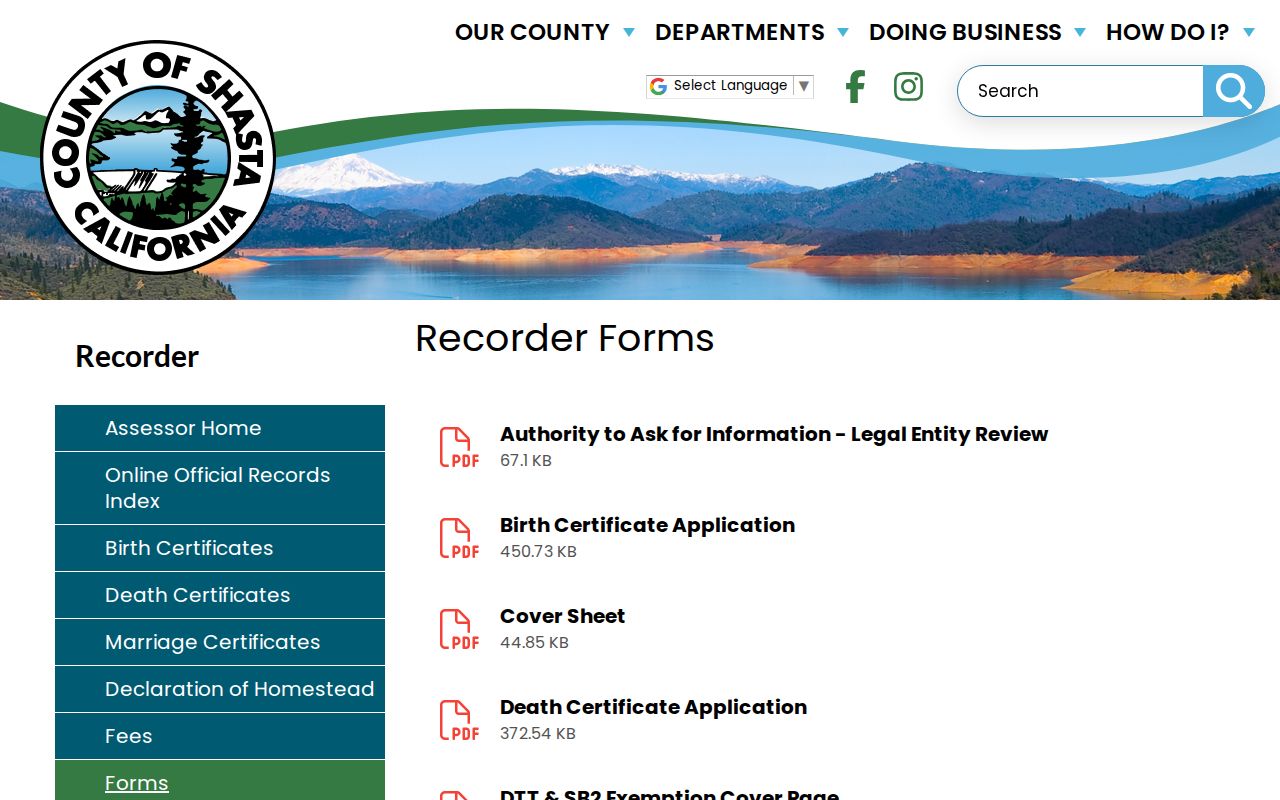
The form list points readers to the correct application instead of treating every Recorder service as a general open-records request.
Police Records Across Redding
Law-enforcement records use agency-specific channels. The Shasta County Sheriff's Office provides an in-custody lookup and a records route for crime or incident reports. A report applicant can download or request an application, call first to ask if the report is ready, submit it to the Records Unit, or email sheriff@co.shasta.ca.us. The records phone is 530-245-6000. Jail questions go to 530-245-6100. Current custody information can also be checked online.
The Sheriff's records page is the county route. Incidents handled by Redding Police belong with the city department instead. A request is not a promise of full release. Active investigations, juvenile information, victim details, and other protected facts may be withheld or redacted. State prison custody belongs to CDCR, while federal custody belongs to the federal inmate system.
VINE supplies victim notification and live operator help around the clock in English and Spanish. It supplements a safety plan and should not be the only protection source.
Redding Records for Heir Research
Probate files, deeds, obituaries, and historical directories form the strongest official route for an heir or family-history question. Start with the Shasta Superior Court probate index for a decedent, executor, estate, and case number. Recorded deeds can trace ownership into or out of an estate. A courthouse file may carry relationships or addresses that an online index does not display.
Older material calls for a different access chain. The Shasta Historical Society holds early marriage records, registered-voter records, cemetery records, family files, and coroner records from 1850 through 1935. The Redding Library has newspapers and microfilm, while the California State Archives county collections include probate, court, naturalization, deed, homestead, vital, marriage, and Great Register materials where held. These sources add context without forcing a modern portal to answer an older question.
Note: Historical access may require an appointment, a written research request, library help, or an archive inquiry rather than an instant download.
Redding Records Before the County Seat
Shasta County was one of California's original counties in 1850, but Redding did not become the county seat until 1888. Early deeds, probate matters, court records, and local registers can therefore be Shasta County records without appearing under a modern Redding office label. The move in civic geography explains why a search limited to recent city terms can miss a valid historical record.
For pre-digital work, record the county, date, record type, names, and any book-page or case reference before contacting the archive or local repository. That small citation lets staff search an older register or microfilm run far more precisely. It also keeps a newspaper mention, directory listing, or family note separate from the official record it points toward.
Redding Record Privacy Boundaries
California draws a firm line between an open government record and protected personal data. Sealed and juvenile cases, many adoption files, confidential voter entries, protected vital-record copies, military discharge papers, and sensitive investigative details are not made open merely because someone submits a request. Remote court display may also be narrower than courthouse access.
Safe at Home gives eligible participants a substitute mailing address and related confidentiality protections. Under Government Code § 6209.5(a), a participant may seek replacement of a residential address on deeds and related property filings with the designated address. The California Safe at Home program explains the protection. Social Security numbers, signatures, government IDs, and similar identifiers may also be removed from a released copy.
Consumer privacy deletion rights do not erase source documents held by a public custodian. Government-record information is treated differently from a private data broker's compiled profile. Use official records only for lawful personal, family, consumer-safety, or civic purposes, and never to stalk, harass, threaten, or intimidate another person.
Requesting Redding Public Records
The California Public Records Act, Government Code § 7920.000 et seq., applies to reasonably described, nonexempt records held by state and local agencies. An agency generally has 10 days to determine whether a request seeks disclosable records. Written notice may extend that determination by up to 14 days in unusual circumstances. Inspection can occur on site, and requester equipment may be used to photograph records when it will not damage them or compromise a system.
Shasta County uses NextRequest and also accepts requests by email at prarequest@shastacounty.gov. The city uses JustFOIA. Court and divorce records go to Shasta Superior Court, not either general portal. Keep confidential facts out of a public request description. Shasta County permits anonymous requests, but an anonymous user must monitor the portal and may miss clarification notices. An account is needed when attaching documents.
- Identify the office that created or keeps the record. Separate city, county, court, and state material.
- Check the official index, prior requests, and published documents before filing a new request.
- Describe the record type, department, date range, names, and subject narrowly. Do not include a Social Security number or other needless private data.
- Submit county material through Shasta County NextRequest or send the county email. Use Redding JustFOIA for city records.
- Review the response, pay direct duplication or statutory charges when required, and narrow the request if the office needs a clearer scope.
The California DOJ's CPRA explanation distinguishes the state law from federal FOIA and summarizes inspection, timing, and judicial remedies.
Redding Records Offline Fallbacks
A blank portal result is not final proof that no record exists. Some systems require a disclaimer, run through JavaScript, omit online images, or limit remote display. When an index fails, move to the documented fallback instead of guessing.
- Call or visit the Recorder for official-document images, certified copies, maps, and certificate forms.
- Use CF-055, mail, or the courthouse Records Department for court searches and copies.
- Ask the Assessor about ownership or assessment questions that a GIS layer cannot settle.
- Send city permit and municipal questions to Redding, but route unincorporated parcel matters to Shasta County.
- Use the Sheriff report form, phone, or email when no public report index exists.
- Ask the library, historical society, or State Archives for older directories, probate sources, newspapers, and registers.
Bring the strongest citation available: a parcel number, assessment number, document number, case number, book and page, exact date range, or full names with variants. It saves staff time and makes a focused response more likely.